About us
What is Montessori?
Foundations of the Montessori Method
Foundational principles, specially trained teachers, the prepared classroom environment, and diverse age groups form the core of Montessori education. It is a whole-child approach to learning, which allows teachers to meet children where they are to help them reach where they want to be.
For deeper insights into our approach, visit our blog page.
If you prefer real-time conversation, please give us a call at 703-729-7200. We’re happy to speak with you anytime (honestly, we could talk about this stuff all day!)
Practical Life
Purpose: Independence, coordination, concentration and self-control Practical Life activities help children learn how to care for themselves, their environment, and others. Through real tasks; pouring, cleaning, food preparation, sorting etc. Children develop confidence as they refine their abilities. These activities also lay the foundation for academic work by strengthening focus, order, and persistence.
Sensorial
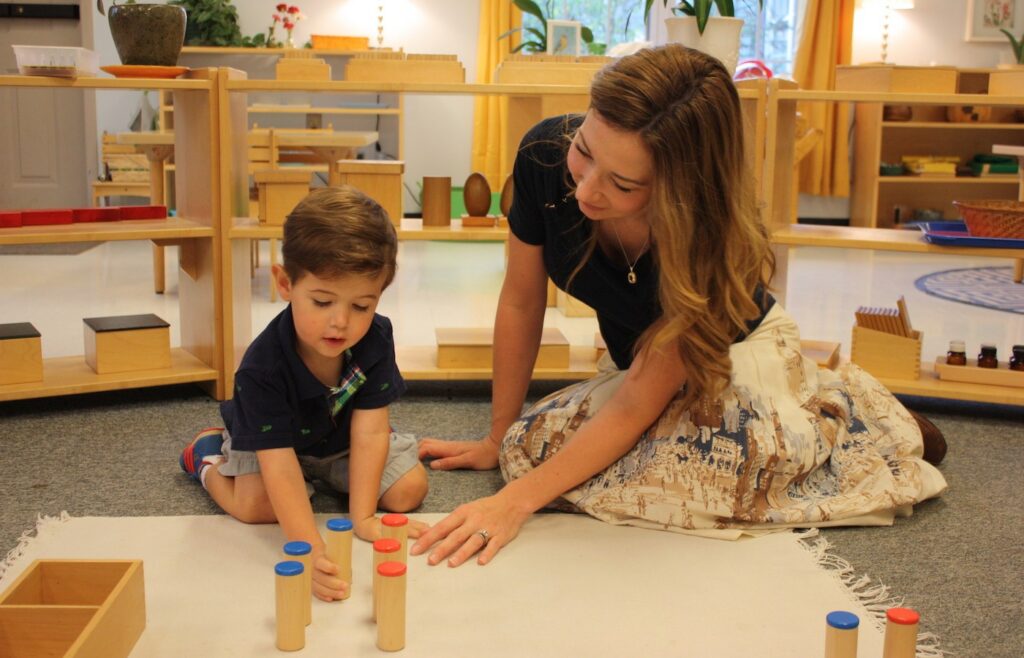
Purpose: Organize the mind and make sense of the physical world By working with materials that isolate qualities such as size, shape, color, sound, and texture, children build the cognitive structures needed for later abstract thinking in math, language, and science. Many lessons given by the teacher require increased patience and focus as the work becomes more complex.
Language
Purpose: Language as expression and construction, not memorization. Montessori language development begins with rich spoken language and progresses naturally toward reading and writing. Children work with hands-on, multi-sensory materials that connect sounds to symbols, supporting phonemic awareness, vocabulary, and early literacy, often before formal reading instruction begins.
Math
Purpose: Understanding quantity before symbols and math operations. Montessori math introduces concepts concretely before moving to abstraction. Children physically handle quantities—counting, comparing, and manipulating materials—so numbers have meaning right from the start. This builds true number sense, not rote performance.
Philosophy/Methodology
Our philosophy leads us to view each child as an individual so that we may meet them where they are to help them reach where they want to be. We consider the whole child and offer guidance toward the development of emotional/social skills, physical, and academic learning. Children are guided in a non-linear education, in which they will return to previously learned skills for refinement, adaptation, and progression toward mastery.
During the first six years of life, our priority is upon the development of executive functioning skills such as problem-solving, inhibitory control, and patience, which combine into emerging leadership. We look toward the adult each child will one day become as we assist them in finding their own interests and strengths and assume their unique places in the classroom community. As their world grows, we partner with each child so that the character traits and social/emotional skills they learn will stay with them long after they leave the classroom.
Physical Environment
The room is specially designed to enable independent growth in each child. The materials in the room are precise, and many of them were created by Dr. Montessori herself to appeal to children as they move through sensitive periods of interest. Everything is child-sized, arranged in an organized way, and placed at the child’s level. There is no “teacher’s desk,” and the room is fully available for all students to explore. The space should feel like the rooms of a home more than a classroom. Here, you’ll find a variety of plants and beautiful artwork, comfortable areas to relax, and furniture made of natural wood. As in the home, children have everything they need to feel a sense of ownership and to care for themselves, each other and the environment.
Mixed Age Grouping (Primary and up)
The three-year age span in the environment ensures that there is something for everyone. In fact, without this element of Montessori, the philosophy/methodology and physical environment will only go so far. This is mainly due to the fact that all children are considered teachers in their own way. The Montessori guide helps children to form a self-sustaining community where they can learn from one another. Older children model leadership, while younger children are encouraged to find connections with their older peers. The materials fill an extensive range from simple to complex so that all children will find meaningful and personally relevant work.
More than 100 years ago, Dr. Montessori created a method of education that focuses on
the development of the whole child. Science and modern educational theory are only just now catching up with her. Through her work, she came to understand both the unique and universal needs of children. She was able to apply her scientific knowledge as a doctor in designing a classroom environment that considers every aspect of the child. Dr. Montessori laid out a philosophy that promotes peace, independence, respect, and friendship. She designed manipulative academic materials for a comprehensive range of abilities and created a method of training teachers to guide
children through their own developmental pathways. At MAB, we combine all of these elements with a faculty of master teachers to provide an authentic Montessori experience for each child and parent.
Elevating the Standard of Early Childhood Education
Montessori Academy will take your child's education to another level
with personalized guidance at every step.